Showing posts with label Future Inspiration. Show all posts

Monday, 21 September 2026

21/09/26 - Soho

Searching for the previously undiscovered


Walk 3 in London's Hidden Walks finds me in probably my most visited part of town, Soho. How it changes - when I first came, 30 years ago, I can remember a pimp offering services, with me answering "no", until we both laughed. "Do I want a woman? Do I want a man? Well what do you want then?"

It's all sanitised now. The council refuses new alcohol licences unless there is table service to seated drinkers. After dark, I was surprised to see organised walking tours emerge, led by umbrella-wielding guides and followed by a posse of foreign thrill-seekers, presumably in search of London's darker side.

There's a job there for me, I am sure.

My guide-book runs to about 20 pages of descriptions, with every other building having a story to tell. I'll limit the blog to just the bits that are of interest and new to me. 

Into Soho
Into Soho

You'll be unsurprised that most are drinking related. Later in the night, I will be completing a Fitzrovian Pub Crawl - attempting to recreate the golden era of London drinking. Very much along that theme is the Colony Room - and it's more modern, still trading counterpart, the Groucho Club sitting side-by-side in Dean Street.

The Colony Rooms - 41 Dean Street
The Colony Room above Ducksoup
The Groucho Club
Groucho Club

The Colony Room was a legendary Soho drinking club at 41 Dean Street, founded in 1948 by Muriel Belcher. It became a bohemian refuge for artists, writers and assorted Soho misfits, with Francis Bacon among its most famous regulars, alongside Lucian Freud, Frank Auerbach and Jeffrey Bernard. The atmosphere was famously louche, abrasive and alcohol-fuelled, with Belcher presiding over her clientele from behind the bar and cultivating an anything-goes attitude. Unlike the Groucho Club's later, more polished version of creative Soho, the Colony Room was resolutely grubby and disreputable. It finally closed in 2008, after six decades of serving as one of London's great drinking institutions; the original premises are now gone, but its reputation as the spiritual home of boozy, argumentative British art remains. 

Let's bring it to life.


On the booze theme, the guide starts the walk at Manette Street (renamed from Rose Street in honour of a Dickens character in A Tale of Two Cities) and the Pillars of Hercules. This was the watering hole for more recent writers, such as Ian McEwan, Martin Amis and Julian Barnes. From the front, it's been rebranded as a cocktail bar - not my cup of Long Island Iced Tea at all - but the rear provides a reminder of its former glory.

Pillars of Hercules, Soho
Lovely Day

Peter Cook's influential Establishment Club - a 1960s comedy club in Greek Street is celebrated with a blue plaque. This doesn't tell the story that the famous picture of Christine Keeler naked on a chair was photographed in the same building. Or that Casanova lived in the building opposite.

The Establishment, Soho
Red Neon advertising a bar of the same name

Moving away from booze and clubs onto writers; 

Bill Bryson was so enamoured with Hazlitt's Hotel in Frith Street that he included a chapter on it in his book "Notes from a Small Island". Georgian, containing many original features, it was bound to appeal to people who live in a country that is not quite as old.

Hazlitts, Soho
Since 1718

I had never heard of the recipient of the next blue plaque - John William Polidori, physician to Lord Byron, whose home was in Great Pulteney Street.  During the same writing competition in Geneva that spawned Frankenstein, he wrote the Vampyre. Initially mocked by Byron and subsequently accused of plagiarism, he returned to this house to commit suicide by drinking acid. 

John Williams Poldori
I wonder who lives there now

This only scratches the guide book's surface, but there is enough to entertain tourists. As long as my umbrella is suitably gaudy and I deliver the tour with panache.

And if the punters want more trivia;

House of St Barnabas Penny Chute
I liked this charity penny chute on the external railings of St Barnabas 


Future Inspiration

Book - Tales from the Colony Rooms - Darren Coffield


Walk Details

Previous Hidden London Walks;

Distance - 4 miles

Geocaches - 21

Walk Inspiration - London's Hidden Walks - Book 1 - Walk 3


Wednesday, 16 September 2026

16/09/26 - Moseley Bog

Tolkien's Middle Earth

It was only a matter of time before the AZ City Walks took us exploring in the footsteps of one of Birmingham's more celebrated sons.

Yet there is still no blue plaque marking his childhood house.

Tolkien's Childhood home
5 Gracewell Cottages is now 264 Wake Green Road

Moseley Bog is closely associated with J.R.R. Tolkien’s childhood and is widely regarded as an inspiration for the Old Forest in The Lord of the Rings. Tolkien moved to nearby Sarehole in 1896, aged four, with his mother and younger brother, and lived there until 1900; he later described his time in the area as among the happiest and most formative of his childhood. He explored the surrounding countryside extensively, including the woodland and former millpond of what is now Moseley Bog, which survived as a relatively wild area while much of the surrounding countryside was later built over. Birmingham City Council notes that Tolkien acknowledged the Bog as an inspiration for the ancient forests in The Hobbit and The Lord of the Rings, while Birmingham Museums connects the wider Sarehole landscape, including Sarehole Mill, with his creation of Middle-earth.

A fair amount of country walking here - Moseley Bog is small, wild and fortunately covered with boardwalks to keep your feet dry. A long section along the River Cole passes a ford crossing and the ripe-for-anagramming Sarehole Mill. Terraced streets at school chucking out time are enough of a reminder that you are in the big city.

Moseley Bog
Over the boardwalk
Sarehole Mill
Haunt
Sarehole Mill
Sarehole Mill

If hairy-footed hobbits, bearded dwarves, lumbering Ents, or assorted orcs, elves and wizards aren't your thing, then maybe an unlikely collection of Grade II listed buildings are.

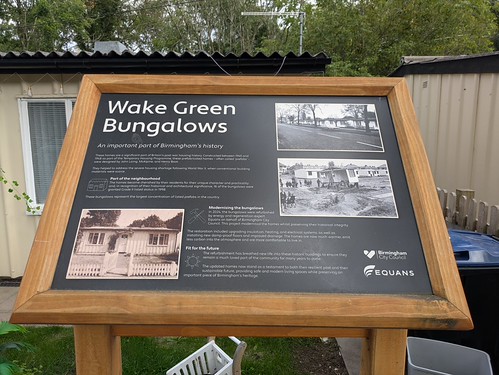
The Wyke Green Prefabs were built at the end of WWII to provide emergency housing. They were designed to last 10 years.

Wyke Green Road Pre-fabs
Unlike Tolkien's House, these get Council recognition
Wyke Green Road Pre-fabs
Prefabs Sprouting

Walk Details

Distance - 4 miles

Geocaches - 6

Walk Inspiration - AZ City Walks, Walk 14

Future Inspiration - The Shires Way, Long Distance Path


Monday, 24 August 2026

24/08/26 - Fitzrovia and Bloomsbury

All Manner of Artist

Second "Hidden Walk" in an attempt to reacquaint myself with Central London. This time it is Fitzrovia and Bloomsbury - the land of the Bohemians. I have so much future inspiration from this walk, I can hear my other projects weep. It's not every area of London that is named after a pub. I am rather enjoying reading "The Fitzroy: An autobiography of a London Pub". To the extent that I have a 1950s-themed pub crawl planned for another day.

An overview of the area;

Fitzrovia and Bloomsbury form a historic swathe of central London immediately north of Mayfair and Soho, with a character that is noticeably more literary, bohemian and intellectual. Fitzrovia developed as a mixed residential and commercial district, becoming particularly associated with artists, writers and musicians, including George Orwell, Dylan Thomas and Augustus John, while its pubs, workshops and small streets retain something of that unconventional past. Bloomsbury, by contrast, was largely shaped by the Russell family from the 17th century onwards and is renowned for its garden squares, grand terraces and intellectual associations, particularly with the British Museum, University College London and the Bloomsbury Group. Together, the two neighbourhoods offer a fascinating mixture of Georgian town planning, literary history, medicine, academia, pubs and bohemian London, stretching from Oxford Street north towards Roughly bounded by Great Portland Street to the west and Gray's Inn Road to the east.


A uniform layout of streets and impressive squares, mainly Georgian and early Victorian. The Post Office Tower dominates the skyline.

Post Office Tower
From the Euston Road

This is a morning walk, so too early for watering holes. The Fitzroy is important to comment upon, responsible for the naming of the area in its bohemian glory years of the 1920s to the 1940s. I am part way through the previously mentioned book, reaching the start of the decline in 1955. A court case for running a house of ill-repute, when homosexual men were observed "fingering sailor's buttocks" by undercover detectives. The people and their other haunts have provided much future reading material and a new pub crawl for me to follow.

The next big source of inspiration is Hawksmoor. St George's, one of his six London churches, is on route. The distinctive tower featuring in the background of Hogarth's Gin Lane. 

The Fitzroy, Fitzrovia
Looking forward to exploring in September

Don't miss the more upbeat "Beer Street".

Google Maps suggests the church is open daily from 9am. It appears that the church opening times are as inconsistently vague as pub opening hours. Gates are padlocked and access to the Hawksmoor (and suffragette) exhibitions are out of reach. Further research into the potential satanic layout of the six churches, via Iain Sinclair and Peter Ackroyd, will be required – and another walking route will be born.

St George's
Hawksmoor - St George's
St George's
Charles II in Roman Garb, atop Hogarth's Tower

For the quirky - again, I am too early for the most famous (how many are there?) of London's Umbrella shops - James Smith and Sons. It saved me from myself. I fancied a heavy-topped walking stick to fight off phone thieves.

James Smith and Son Umbrella Shop
Summer of 2026 - Worst trading conditions ever

And inside University College - one of the most bizarre sights in London. The corpse of Jeremy Bentham on display in a glass cupboard in the reception area. He died in 1832 and his will requested that his dressed body should be put on display as a "self-statue". Of course, the medical students have been messing around with it over the years. The head now a wax replacement.

Jeremy Bentham
Auto Icon

That's plenty for a blog - more photos of pubs, squares, Coram Fields, St George's Gardens and Tracy Emin artworks hidden in plain sight on a railing on the Komoot map below.

Future Inspiration

Book - The Fitzroy: An autobiography of a London Pub, Sally Fiber
Book - The Laughing Torso, Nina Hamnett
Book - Queens of Bohemia and other Miss-fits, Darren Coffield
Artist - Augustus John
Book - Lud Heat, Iain Sinclair
Book - Hawksmoor, Peter Ackroyd

Walk Details

Previous Hidden London Walks - Mayfair

Distance - 5.5 miles

Geocaches - c20

Walk Inspiration - London's Hidden Walks - Book 1 - Walk 2